

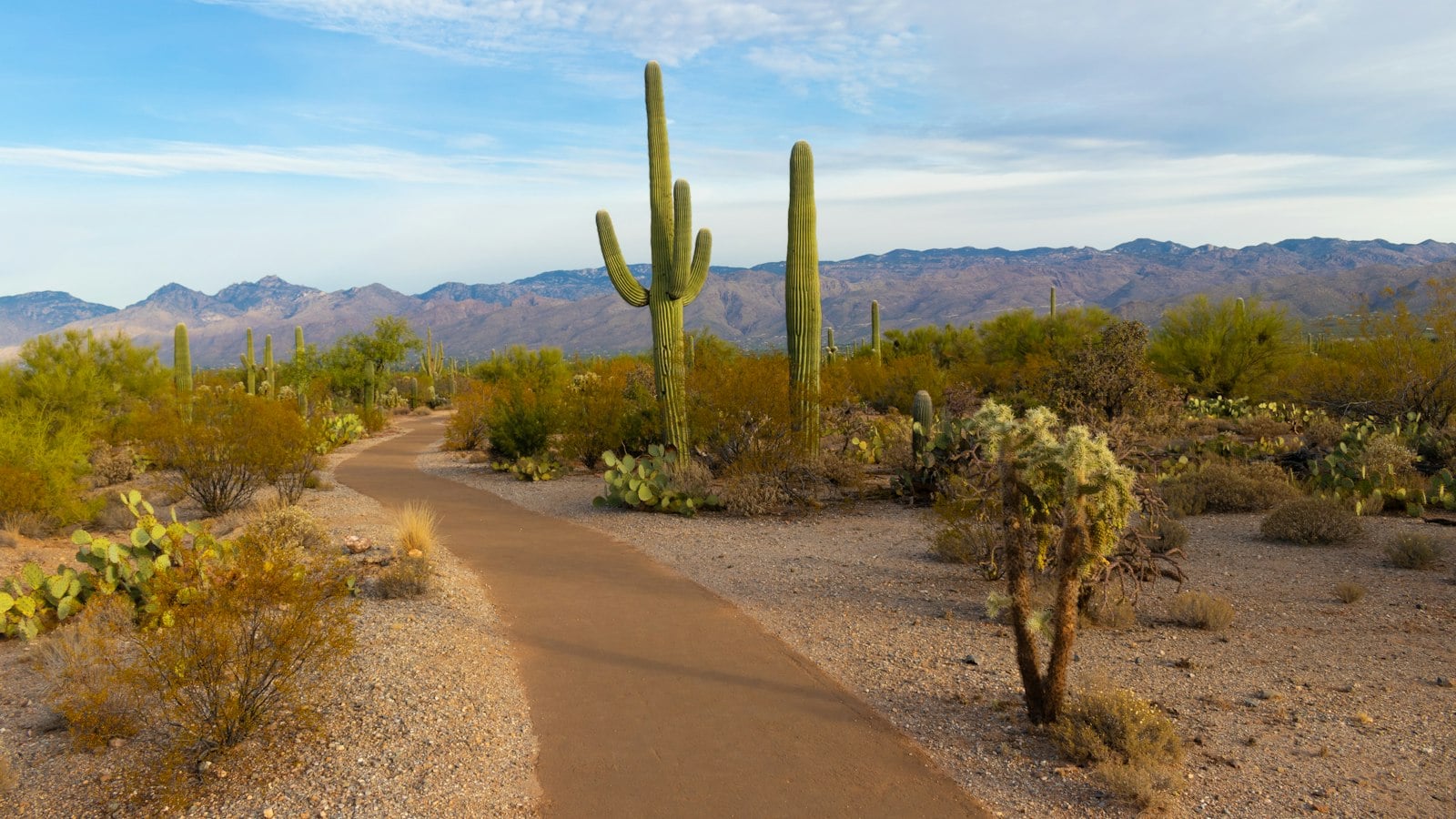
Tucson vs Phoenix is the question we hear on almost every first relocation call. The two cities sit about two hours apart on I-10, but they live like two different states. The short version: Tucson wins on home prices, heat, traffic and new-construction commutes; Phoenix wins on jobs and big-city amenities. Which one is right for you depends on how you earn your income and the life you want day to day.
Angie Kuzma of Stratton Real Estate Group goes round by round on Tucson vs Phoenix: home prices, heat, traffic, jobs, lifestyle and growth. Full transcript below.
Tucson vs Phoenix at a glance
| Category | Tucson | Phoenix | Edge |
|---|---|---|---|
| Typical home price (2026) | Mid-$300,000s | Around $450,000 (metro) | Tucson |
| Metro population | About 1 million | About 5 million | Depends on you |
| Elevation | About 2,400 ft | About 1,100 ft | Tucson (cooler) |
| Typical commute | 25–30 minutes across town | 45 minutes is normal | Tucson |
| Job market | University, healthcare, aerospace, defense | Corporate HQs, finance, tech, semiconductors | Phoenix |
| Lifestyle | Five mountain ranges, laid-back, UNESCO food city | Pro sports, major airport, nightlife | Tie |
| New-construction areas | Marana, Vail, Sahuarita (20–30 min to central Tucson) | Buckeye, Queen Creek (long commutes) | Tucson |
Round 1: Is Tucson cheaper than Phoenix?
Yes, and by real money. In the video Angie puts the gap at roughly $130,000 on a typical home. Depending on the data source and month, the Tucson median has run in the mid-$300,000s through 2026 while the Phoenix metro has hovered around $450,000, so plan on a difference of $100,000 or more.
What that buys you: in Tucson, the budget that gets you a smaller home, a smaller lot or a longer commute in the Phoenix suburbs often gets you a newer single-story home in Marana or Vail, frequently with mountain views. Property taxes are fairly similar in both metros, and both have plenty of HOAs, so don’t assume either is HOA-free. For current numbers by town, see our Tucson housing market by town report.
Winner: Tucson.
Round 2: Is Tucson cooler than Phoenix?
A little, and it matters. Both cities are hot in summer, but Tucson sits at roughly 2,400 feet versus about 1,100 feet for Phoenix. That elevation usually makes Tucson a few degrees cooler with fewer days over 110°F.
The bigger difference is at night. Phoenix has so much concrete and asphalt that it holds heat, and midsummer midnights can still be in the 90s. Tucson cools off more, especially toward the Catalina Foothills and the edges of town, often with a 30-degree swing between day and night. Monsoon season (July through September) brings dramatic storms off the mountains. Phoenix gets monsoons too, but usually less often.
Winner: Tucson. Not because it isn’t hot, but because it’s a little less brutal.
Round 3: Traffic, commutes and city size
The Phoenix metro is about 5 million people; Tucson is about 1 million. In Phoenix a 45-minute commute is normal and the freeways are packed. In Tucson most people get across town in 25 to 30 minutes. The honest catch: Tucson has no freeway through the middle of town, so cross-town drives are mostly surface streets with a lot of traffic lights. You’ll still spend less time in the car.
Winner: Tucson.
Round 4: Is Phoenix or Tucson better for jobs?
Phoenix punches back hard here. It has a much bigger job market: corporate headquarters, finance, tech and the large semiconductor plants going up in the north Valley. If you work in corporate, sales, tech or finance and need to find a job locally, Phoenix gives you far more options and usually higher pay.
Tucson’s economy leans on the University of Arizona, healthcare, aerospace and defense, including Raytheon and Davis-Monthan Air Force Base. Those are stable employers, but wages tend to run lower. If you’re retiring, working remotely or bringing your job with you, this round barely matters.
Winner: Phoenix if you need a local job.
Round 5: Lifestyle and the outdoors
Tucson is surrounded by five mountain ranges, and from most of town you can be on a trail in about 15 minutes. In summer you can drive up Mount Lemmon and be 20 to 30 degrees cooler in about an hour, and Saguaro National Park sits on both sides of the city. Tucson was also the first UNESCO City of Gastronomy in the United States, so the Sonoran food scene is the real thing. People who move here say it feels like a community, not a sprawling metro.
Phoenix has great outdoor spots like Camelback and South Mountain, but nature feels farther away. Where Phoenix wins is the big-city package: pro sports, a major airport with direct flights almost anywhere, big concerts, and more shopping and nightlife.
Result: Tie. It depends on the life you want.
Round 6: Growth and new construction
Both metros are growing fast. In Phoenix, much of that growth is far out on the edges in places like Buckeye and Queen Creek, which can mean long drives into the city. Tucson’s main growth areas are Marana, Vail and Sahuarita, mostly 20 to 30 minutes from central Tucson, so you get a new home without giving up your day to driving.
One caution for both cities: builders are offering big incentives right now, like rate buydowns and closing-cost credits. The person in the model home works for the builder, not for you. Bring your own agent before you walk into a model so someone is negotiating on your side. More on that in new construction vs resale homes in Tucson.
Winner: Tucson.
The verdict: should you move to Tucson or Phoenix?
Tucson wins the scorecard 4–1 with one tie, but a scorecard doesn’t decide where you live. Your life does.
Choose Phoenix if you:
- Need to find a corporate or tech job locally
- Want big-city energy with pro sports and nightlife
- Fly a lot for work or fun and want a major airport
Choose Tucson if you:
- Are retiring, work remotely, or bring your income with you
- Want more home for your money
- Love the outdoors and want a slower pace and real community feel
Our advice to every client: visit both. Spend a weekend in each, and if you can, come in summer. If you can handle Tucson in July, you’ll love it the other nine months.
Frequently asked questions
Is it cheaper to live in Tucson or Phoenix?
Tucson is cheaper for housing. In 2026 the typical Tucson home sells for roughly $100,000 or more below the Phoenix metro median, which sits around $450,000. Property taxes are similar in both cities, and both have plenty of HOA communities, so the purchase price is where most of the savings show up.
Is Tucson cooler than Phoenix?
Usually a few degrees, yes. Tucson sits at about 2,400 feet of elevation versus roughly 1,100 feet for Phoenix, so it typically sees fewer days over 110°F. The bigger difference is at night: Phoenix’s concrete holds heat and can stay in the 90s at midnight, while Tucson cools off more, especially near the foothills.
How far apart are Tucson and Phoenix?
About two hours by car on Interstate 10, roughly 115 miles depending on where you start and end.
Is Phoenix or Tucson better for jobs?
Phoenix. It has a much larger job market with corporate headquarters, finance, tech and the new semiconductor plants in the north Valley, and pay usually runs higher. Tucson’s economy is anchored by the University of Arizona, healthcare, aerospace and defense, including Raytheon and Davis-Monthan Air Force Base. If you work remotely, are retiring or are bringing your job with you, this matters much less.
Is traffic worse in Phoenix or Tucson?
Phoenix. The metro has about 5 million people compared with roughly 1 million in Tucson, and a 45-minute commute is normal there. Most people get across Tucson in 25 to 30 minutes, though most cross-town drives are on surface streets with traffic lights because Tucson has no freeway through the middle of town.
Where is new construction in the Tucson area?
Most new-home growth is in Marana, Vail and Sahuarita, generally 20 to 30 minutes from central Tucson. In Phoenix, much of the growth is far out on the edges in places like Buckeye and Queen Creek, which can mean long commutes.
Should I use my own agent when buying a new-build home?
Yes. Builders in both cities are offering incentives like rate buydowns and closing-cost credits, but the salesperson in the model home works for the builder. Bring your own agent on the first visit so you are represented when those incentives are negotiated.
Who should choose Tucson over Phoenix?
Tucson tends to fit retirees, remote workers and anyone bringing their income with them, plus buyers who want more home for the money, easy access to the outdoors and a slower, community feel. Phoenix fits people who need to find a corporate or tech job locally, want big-city sports and nightlife, or fly often and want a major airport.
Get help deciding between Tucson and Phoenix
Stratton Real Estate Group has helped more than 3,000 families buy, sell and relocate, with 1,200+ five-star reviews. We live and work in Tucson and also have agents in Phoenix, so we can help you in either city. Book a free relocation call and we’ll walk you through neighborhoods, prices and what to watch out for, no pressure. Prefer to talk now? Contact our Tucson team, browse the Tucson real estate FAQ, or, if Phoenix is the pick, start with our Phoenix relocation guide.
Video transcript: Moving to Tucson vs Phoenix? Watch This Before You Decide
I sell homes in Tucson for a living, so you’d expect me to tell you that Tucson wins this one. But I’m going to be real with you, because for some of you watching, Phoenix is actually the better move. And if you pick the wrong city, it’s a very expensive mistake to undo. So today we’re going round by round: home prices, heat, traffic, jobs, lifestyle, and where each city is headed. By the end, you’ll know exactly which one fits you best.
If you’re new here, I’m Angie Kuzma with the Stratton Real Estate Group. We’ve helped over 3,000 families buy, sell and relocate to the Tucson area. Every week we help people moving from places like California, Washington, Illinois and Colorado figure out where they actually want to land in Arizona, and Tucson versus Phoenix is a question I get on almost every first call. They’re only about two hours apart on I-10, but they feel like two completely different states.
Round one, home prices. Right now, the median home price in Tucson is around $320,000. In the Phoenix metro area, it’s closer to $450,000. That’s a difference of roughly $130,000 on a typical home. In Tucson, that budget can get you a newer single-story home in a suburb like Marana or Vail, often with mountain views. In the Phoenix suburbs, the same money usually means a smaller home, a smaller lot, or a longer drive to work. Property taxes are fairly similar across both, and both have plenty of HOAs, so don’t assume either one is HOA-free. But on purchase price alone, Tucson wins this round.
Round two, the heat. Yes, both cities are hot. I’m not going to pretend our summers are mild. But Tucson sits at about 2,400 feet of elevation and Phoenix is around 1,100 feet. That extra height usually means Tucson runs a few degrees cooler, and we typically see fewer days over 110 degrees. The bigger difference is at night. Phoenix has so much concrete and asphalt that it holds heat, so in the middle of summer it can still be in the 90s at midnight. In Tucson, our nights cool off more, especially toward the foothills and the edges of town. We often get a 30-degree difference between daytime and nighttime. And there’s monsoon season, July through September, with dramatic storms rolling off the mountains. Phoenix gets monsoons too, but usually much less often. This round goes to Tucson, not because it isn’t hot, but because it’s a little less brutal.
Round three, traffic and size. The Phoenix metro is about 5 million people. Tucson is about 1 million. In Phoenix, a 45-minute commute is pretty normal and the freeways are packed. In Tucson, most people get across town in 25 to 30 minutes. Tucson doesn’t have a freeway running through the middle of town, so most cross-town drives are on surface streets with a lot of traffic lights. People do complain about that, but overall you’ll spend less time in your car here. Tucson takes this one.
Round four, jobs and salaries. Here’s where Phoenix punches back hard. Phoenix has a much bigger job market: major corporate headquarters, finance, tech, and the huge semiconductor plants going up in the north Valley. If you work in corporate, sales, tech or finance and need to find a job locally, Phoenix gives you far more options and usually higher pay. Tucson’s economy leans on the University of Arizona, healthcare, aerospace and defense, including Raytheon and Davis-Monthan Air Force Base. Those are great, stable employers, but wages tend to run lower here. If you’re retiring, working remote, or bringing your job with you, this round doesn’t matter as much. If you need to find a job when you get here, Phoenix wins.
Round five, lifestyle and the outdoors. Tucson is surrounded by five mountain ranges. You can be on a trail in 15 minutes from most parts of town. In the summer you can drive up Mount Lemmon and be 20 to 30 degrees cooler in about an hour, and we have Saguaro National Park on both sides of the city. Phoenix has great outdoor spots too, like Camelback and South Mountain, but it’s more spread out and nature feels farther away. Where Phoenix wins is the big-city stuff: pro sports teams, a major airport with direct flights almost anywhere, huge concerts, and more shopping and nightlife. Tucson feels more laid-back, and our food scene is a big deal. Tucson was named the first UNESCO City of Gastronomy in the United States. People who move here say it feels more like a community and less like a sprawling metro. I’m calling this one a tie.
Round six, growth and new construction. Both cities are growing fast. In Phoenix, a lot of that growth is way out on the edges, in places like Buckeye and Queen Creek, which can mean really long commutes. In Tucson, our main growth areas are Marana, Vail and Sahuarita, and most of these are still about 20 to 30 minutes from central Tucson. One caution for both cities: builders are offering big incentives right now, like rate buydowns and closing-cost credits. That’s great, but you need your own agent with you. The person in the model home works for the builder, not for you. With growth and new construction, Tucson wins.
The verdict. On the scorecard Tucson wins, but a scorecard doesn’t decide where you should live. Your life does. Choose Phoenix if you need to find a job locally in corporate or tech, want big-city energy with pro sports and nightlife, or fly a lot and need a major airport. Choose Tucson if you’re retiring, work remotely or bring your income with you, want more home for your money, love the outdoors, and would rather have a slower pace and a real community feel. Here’s what I tell our clients: visit both. Spend a weekend in each, and come in the summer if you can. If you can handle Tucson in July, you’re going to love it here the other nine months.
Whichever city is starting to feel like the one, the next step is figuring out which part of town fits you. I live and work in Tucson, and our team also has agents in Phoenix, so we can help you in either city. Book a free relocation call with our team and we’ll walk you through neighborhoods, prices and what to watch out for, with no pressure.
Market figures are approximate, vary by data source and month, and are provided for general comparison. Contact us for current numbers on a specific neighborhood. Equal Housing Opportunity.