
Frank Lloyd Wright, One Remarkable Woman, and the Architectural Masterpiece That Made a Statement
Some people renovate their homes.
Others commission a famous architect, embrace an extraordinary vision, and create something so spectacular that people are still talking about it more than a century later.
Susan Lawrence Dana belonged firmly to the second category.
And thank goodness for that.
Because tucked into Springfield, Illinois, is one of the most extraordinary examples of American residential architecture—a house that manages to be elegant, imaginative, historically significant, and just a little bit outrageous.
The Dana-Thomas House is more than a beautiful building.
It's a remarkable story about ambition, art, innovation, social life, and a woman who was apparently not interested in doing anything halfway.
When a Renovation Becomes a Masterpiece
The story begins with a house built in 1868.
Perfectly respectable.
Historically appropriate.
And evidently not quite sufficient for the ambitions of its future transformation.
In 1903, Susan Lawrence Dana commissioned architect Frank Lloyd Wright to dramatically remodel her family's existing Italianate residence.
Wright was developing ideas that would become central to his architectural identity.
Dana had the resources, ambition, and social interests to embrace something extraordinary.
Together, they created a remarkable example of Prairie-style architecture.
The project expanded far beyond an ordinary renovation.
According to the Frank Lloyd Wright Foundation, the finished house contained 35 rooms and became the largest building Wright had designed at that stage of his career.
Thirty-five rooms.
For context, that's enough space to lose your reading glasses in an entirely different wing of the house and simply decide to purchase another pair.
But the scale was only part of the story.
What made the Dana-Thomas House extraordinary was the relationship between its architecture, furnishings, decorative details, and intended social purpose.
Susan Lawrence Dana Had Something to Say
Susan Lawrence Dana was not simply interested in possessing an impressive residence.
She was a progressive-minded social figure whose interests included education, community involvement, and social reform.
Her home was intended to accommodate gatherings, cultural activities, and intellectual exchange.
That helps explain why its design became so elaborate.
The house wasn't conceived merely as a collection of bedrooms surrounding a spectacular living room.
Its spaces were intended to support a particular kind of social life.
There were areas for entertaining.
Rooms that encouraged interaction.
Architectural details that created atmosphere and drama.
The residence communicated ideas about culture, sophistication, and the possibilities of modern living.
It was, in a sense, both a home and a statement.
And unlike most statements made at elaborate parties, this one has aged remarkably well.
Frank Lloyd Wright Didn't Believe in Ordinary Rooms
Frank Lloyd Wright approached residential design with an unusual degree of artistic control.
He wasn't necessarily satisfied with designing the walls and leaving everyone else to choose the furniture.
Architecture, interior spaces, lighting, decorative materials, and furnishings could all contribute to one unified vision.
At the Dana-Thomas House, that philosophy is especially visible.
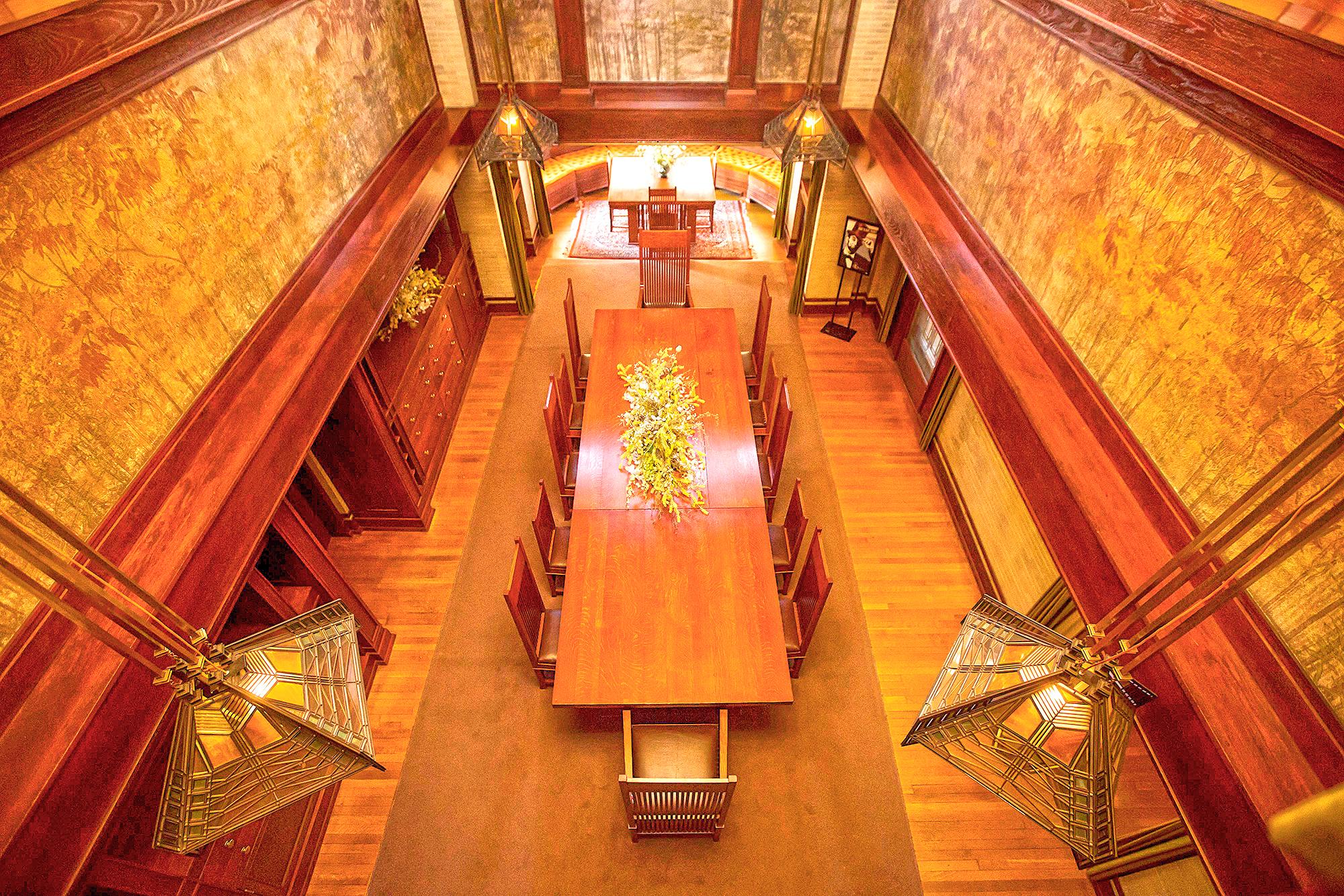
The residence contains more than 100 pieces of original Wright-designed furniture, along with an extraordinary collection of art glass.
Nature-inspired patterns and decorative details create connections between indoor spaces and the surrounding world.
Wood, natural colors, carefully organized spaces, and artistic ornamentation help create a sense of continuity.
Rather than treating every room as an isolated decorating project, Wright approached the house as a complete artistic composition.
Which is wonderful, provided you're comfortable with the architect having extremely strong opinions about your furniture.
The Art Glass Deserves Its Own Applause
One of the house's most memorable features is its remarkable decorative glass.
The Illinois Department of Natural Resources describes a collection of more than 250 works of original art glass, while the Frank Lloyd Wright Foundation identifies an even broader collection of original Wright-designed objects.
The glass designs incorporate abstracted natural forms, geometric relationships, and patterns connected to the Prairie School aesthetic.
In different lighting conditions, these decorative elements can transform the atmosphere of a room.
They're not simply windows.
They're part of the architectural experience.
Imagine commissioning a home where the glass, furniture, lighting, and spatial organization all participate in a carefully considered artistic vision.
Now imagine trying to explain that design philosophy to someone whose primary concern is whether the dining table is close enough to an electrical outlet.
Different priorities.
Both understandable.
A House Designed for Extraordinary Gatherings
The Dana-Thomas House contains spaces that reveal how important entertaining was to its original vision.
Its barrel-vaulted dining room and gallery are particularly distinctive.
Architectural features create a sense of ceremony.
Changes in ceiling height, movement between spaces, and carefully designed details make the interior experience more dramatic than a conventional floor plan.
The residence also includes an unusual collection of specialized spaces and amenities.
The point wasn't simply luxury for luxury's sake.
The design supported social interaction, gatherings, cultural expression, and hospitality.
This is one of the more fascinating aspects of historic residential architecture.
Homes reveal how people wanted to live.
They show us what their owners considered important.
And sometimes, they demonstrate a willingness to make a spectacularly ambitious decision about a dining room ceiling.
The Unexpected Power of Preservation
The fact that visitors can still experience the Dana-Thomas House is extraordinary in itself.
Many historically significant buildings have been dramatically altered or demolished.
Others survive only through photographs and architectural records.
The Dana-Thomas House retained much of its original artistic character.
After Susan Lawrence Dana's ownership, the building was acquired by Charles C. Thomas and his wife, whose preservation efforts helped protect it.
Eventually, the State of Illinois acquired the property.
Today, the house is maintained as a historic site and offers visitors an opportunity to experience one of Wright's important early architectural achievements.
Its survival demonstrates the value of historic preservation.
Buildings can function as cultural records.
They tell us about architecture, craftsmanship, social expectations, economic history, and changing ideas about domestic life.
And unlike many historical artifacts, buildings allow people to physically experience the spaces in which those ideas took shape.
What a Century-Old House Can Teach Modern Homeowners
It's tempting to think that a historic architectural masterpiece has very little in common with an ordinary contemporary home.
But the Dana-Thomas House offers lessons that remain relevant.
Good design considers the whole experience.
A beautiful kitchen matters, but so does how the kitchen connects to the rest of the home.
Natural light changes everything.
Windows influence atmosphere, comfort, and how a space feels throughout the day.
Materials create personality.
Wood, glass, texture, and architectural details contribute to a home's character.
Spaces should support the lives people actually live.
A home designed for large gatherings will prioritize different features than one focused on quiet routines.
Originality can outlast fashion.
The most memorable homes often have a coherent identity rather than simply reflecting whatever happens to be popular.
None of these ideas requires a famous architect or a 35-room residence.
Thoughtful design can improve a modest home just as meaningfully as an elaborate one.
Although having 35 rooms does provide considerably more opportunities to demonstrate the principle.
Springfield Has More Than One Extraordinary Story
Springfield is internationally associated with Abraham Lincoln, and understandably so.
But the city's cultural and architectural history extends far beyond its most famous former resident.
The Dana-Thomas House offers a different perspective on Springfield's identity.
It's a story about a visionary woman, an influential architect, artistic experimentation, and the preservation of a remarkable cultural landmark.
It's also proof that fascinating stories are often waiting inside buildings people pass without a second thought.
A structure that appears beautiful from the street may contain extraordinary examples of craftsmanship, innovative design, and history.
Sometimes the most interesting thing about a city isn't its most recognizable monument.
It's the unexpected story that changes how you see everything around it.
The Woman Behind the Masterpiece
Frank Lloyd Wright's name is recognized around the world.
Susan Lawrence Dana's deserves attention in this story, too.
Without her ambition, resources, social vision, and willingness to commission something exceptional, Springfield might not possess this remarkable architectural treasure.
The house reflects the collaboration between a daring client and an architect determined to explore new possibilities.
More than a century later, visitors can still experience the result.
And perhaps that's the greatest achievement of all.
Susan Lawrence Dana wanted a home that communicated culture, imagination, and ambition.
She succeeded so thoroughly that the building continues the conversation long after its original gatherings ended.
Some renovations improve a house.
Others become history.
A Little More Springfield
At Stratton Group, we appreciate the history and architectural character that make Springfield's neighborhoods distinctive.
From historic residences to homes designed for contemporary living, each property has a story of its own.
And as Springfield beautifully demonstrates, sometimes the most extraordinary stories begin right at home.

Check out this article next