

The Desert Has Been Keeping Secrets for Millions of Years
And Tucson Has Been Living in the Middle of Them
There are two kinds of people in the world: those who look at the desert and see a remarkable, intricately balanced ecosystem, and those who see a large collection of rocks and plants that seem deeply opposed to being touched.
Both have a point.
But Tucson's Sonoran Desert is far more interesting than its famously prickly reputation suggests.
Behind the towering saguaros, impossible-looking mountains, and landscapes that appear to have been decorated by an unusually artistic geologist, there is a world of extraordinary relationships, survival strategies, unexpected beauty, and frankly impressive botanical behavior.
Some desert residents can live for centuries. Others emerge for just a few glorious weeks. Certain plants function as nurseries for other plants, while several animals have mastered the art of surviving conditions that would send most humans directly toward the nearest air-conditioned building.
And almost none of this is obvious at first glance.
Welcome to the desert beneath the desert—the one you notice when you stop admiring the scenery long enough to wonder how any of it works.
The Saguaro Has a More Interesting Childhood Than You Think
Consider the saguaro cactus.
It's tall, iconic, instantly recognizable, and has the sort of commanding presence that makes it an excellent candidate for Arizona's unofficial celebrity.
But every enormous saguaro begins as something surprisingly vulnerable.
Young saguaros frequently grow beneath protective trees such as palo verdes, mesquites, and ironwoods. Scientists call these protective companions nurse plants.
The relationship is rather charming.
The tree provides shelter from intense sunlight and damaging winter temperatures, creating a small neighborhood of relative comfort in an otherwise unforgiving environment.
The cactus grows slowly beneath it, building the resilience necessary to survive on its own.
Eventually, the saguaro may tower over the tree that helped it survive.
It's a beautiful ecological arrangement, though perhaps not the sort of retirement plan the nurse tree originally envisioned.
According to the National Park Service, a young saguaro may grow only a few inches during its first decade. Some will live for more than 150 years, and exceptional individuals may exceed 200.
Imagine spending decades growing tall enough to attract attention, only to discover that everyone is mainly interested in whether you've developed arms.
Speaking of which...
Those Famous Arms? They're Not Guaranteed
Saguaro arms are one of the desert's most distinctive features.
They're also wonderfully unpredictable.
Depending on environmental conditions, a saguaro might begin branching at approximately 60 to 75 years of age—or considerably later.
Some grow spectacular collections of arms. Others remain solitary columns their entire lives.
There is no botanical requirement that a saguaro develop the perfect silhouette for a souvenir magnet.
Rainfall, temperature, location, age, and growing conditions all play roles in its development.
This individuality is part of what makes a mature saguaro forest so visually remarkable.
Some plants resemble elegant sculptures. Others look like they're directing traffic. A few appear to be engaged in animated conversations with invisible neighbors.
And after enough time around Tucson, it's difficult not to assign them personalities.
The Desert's Most Unlikely Apartment Building
A mature saguaro isn't merely a plant.
It's also valuable real estate.
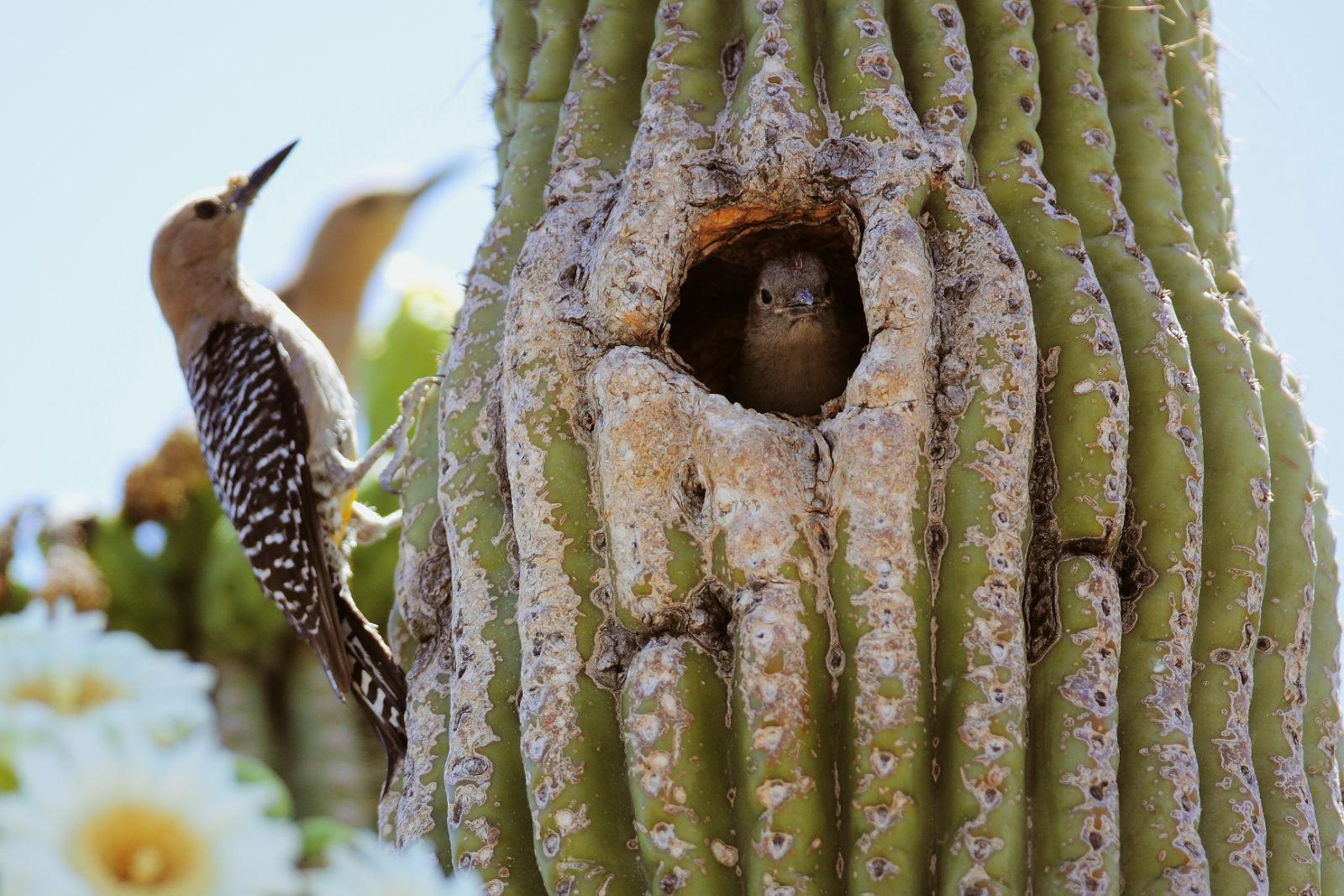
Gila woodpeckers and gilded flickers excavate cavities inside saguaros, creating protected nesting spaces.
Once those original residents move on, other birds may occupy the abandoned cavities.
Elf owls, screech owls, purple martins, and other species can benefit from these ready-made homes.
Larger birds—including hawks—may build nests among a saguaro's arms.
All of which makes a mature cactus something like a vertical apartment complex, except the residents have feathers and nobody seems particularly interested in collecting rent.
The saguaro also contributes food to the ecosystem.
Its flowers support pollinators, while its fruit provides important nourishment and moisture for desert animals.
For the Tohono O'odham people, saguaro fruit has long held cultural significance, including traditional harvesting practices connected to the seasonal calendar.
The cactus isn't simply decorating the landscape.
It's helping sustain it.
The Desert Isn't Empty. It's Extremely Busy.
One of the great misconceptions about desert environments is that relatively little happens there.
This probably comes from visiting at midday, when the sun has convinced practically every sensible living creature to find somewhere else to be.
Desert animals frequently organize their activity around temperature.
Some are nocturnal, becoming active after sunset. Others are crepuscular, concentrating activity around dawn and dusk.
Burrows, rocks, vegetation, and shaded terrain provide shelter from extreme conditions.
This is why a desert landscape can appear nearly motionless while supporting an extraordinary variety of life.
The Sonoran Desert includes birds, mammals, reptiles, insects, and countless organisms contributing to interconnected ecological relationships.
A casual visitor sees a quiet hillside.
An ecologist sees an entire neighborhood.
And if you've ever watched a Gambel's quail sprint across a Tucson street with several tiny chicks following behind, you'll know that neighborhood occasionally has a rather chaotic morning commute.
Even the Mountains Tell Different Stories
Tucson's mountain ranges don't merely provide spectacular backgrounds for photographs.
They also help create striking differences in elevation, climate, and plant life.
Saguaro National Park is divided into two major districts: the Tucson Mountain District to the west and the Rincon Mountain District to the east.
The eastern district extends from Sonoran Desert vegetation into much higher elevation habitats, including oak woodland and coniferous forest.
That means a journey through the landscape can reveal dramatic ecological changes.
The desert is not a single, uniform environment.
It's a collection of overlapping worlds, each shaped by elevation, moisture, sunlight, geology, and the species capable of thriving there.
The remarkable thing isn't simply that so many plants and animals survive here.
It's how creatively they've adapted.
What the Desert Can Teach Us About Living Well
There's something refreshing about a landscape that refuses to function on anyone else's schedule.
Saguaros don't rush.
Palo verdes provide shelter without seeking recognition.
Wildlife adjusts its routine when conditions become uncomfortable.
Nature uses shade, orientation, timing, and cooperation as tools for survival.
Humans, meanwhile, will occasionally schedule an outdoor gathering in the middle of an Arizona summer and then express genuine surprise when everyone looks miserable.
The desert may have something to teach us.
For Tucson homeowners, that lesson is practical as well as poetic.
Thoughtful landscaping, appropriate shade, water-conscious plant selection, and an understanding of the local climate can make outdoor spaces more comfortable and compatible with the surrounding environment.
A beautiful desert property doesn't necessarily require forcing a lush, water-intensive landscape into a place where it was never meant to flourish.
Sometimes the best design decision is recognizing what already belongs.
Tucson's Greatest Luxury Might Be Its Landscape
Cities spend extraordinary amounts of money trying to develop memorable identities.
Tucson has something no marketing campaign could manufacture: an extraordinary living landscape with a story unfolding over centuries.
The saguaros are not simply scenery.
The mountains are not merely decoration.
And the quiet spaces between them are rarely as empty as they appear.
The next time you pass a mature cactus, consider how much history it may have witnessed.
Then look beneath the nearby trees.
You might find the next generation growing quietly in the shade.
It has absolutely nowhere to be.
And given enough time, it may become one of the most remarkable things in the neighborhood.
A Little More Tucson
At Stratton Group, we believe understanding a community means appreciating far more than its homes. Tucson's landscapes, neighborhoods, and distinctive way of life are part of what makes living here special.
Whether you're discovering the city for the first time or finding new reasons to appreciate it, we're always happy to help you explore what makes Tucson home.

Check out this article next